 BestAIFor
Meta Prompting 2026: Step-Back Techniques for Multi-Model Orchestration
Meta prompting and step-back prompting allow AI models to collaborate, boosting reasoning and reliability in complex tasks
February 9, 2026•10 min read
AI agents are pitched as the thing that finally automates the grunt work of API integration. The evidence from controlled studies and production deployments tells a messier story — real gains on narrow tasks, measurable regressions on the work that actually ships, and an uneven distribution of who captures the upside and who absorbs the costs. The tension worth sitting with: the productivity story depends on who is holding the pager when an agent gets the authentication flow wrong.
Let me walk you through the finding that changed this debate. METR, an independent AI evaluation nonprofit, ran a randomized controlled trial in early 2025 with sixteen experienced open-source maintainers working on their own repositories. The headline, documented in their July 2025 paper: tasks took 19 percent longer with AI tools than without. The developers themselves estimated they were 20 percent faster. That 39-point gap between perception and measurement is the part that matters.
Two caveats are worth naming. First, this was a small study in a specific setting — large, mature codebases where context is everything. It does not generalize to every developer or every task. Second, the directional finding — that experienced developers in familiar codebases are often slowed by current-generation AI tools — has been echoed by smaller evaluations at Google and in informal internal studies that have leaked into public discussion. The specific number will move. The direction is robust.
So the productivity story is not "AI agents make developers faster." It is "AI agents make some developers faster on some tasks, while making other developers slower on other tasks, and most people cannot tell which bucket they are in." That distinction matters when someone is quoted a productivity number in a vendor pitch.
API integration is a useful stress test because it has a clean definition — read another system's contract, write code that conforms, handle the failure modes. In principle, a large language model should be very good at this. In practice, the failure modes cluster in predictable places.
Schema drift. Real APIs version, deprecate fields, and change error shapes between minor releases. An agent working from a training-time snapshot of the documentation cannot know this. Generated client code passes tests against mocked responses and fails against the live service because a field moved from the envelope to the payload three months ago. This is not a model-capability problem. It is a grounding problem. The fix is retrieval over current documentation, not a smarter base model.
Authentication chains. OAuth flows, refresh token rotation, rate-limit handling, retry semantics — these are the parts of integration work that look tedious and in fact cost you production incidents when they are wrong. Anthropic's Computer Use documentation, published when the feature entered beta in October 2024, explicitly flagged multi-step authentication as an unreliable category. The warning has not gone away.
Error-handling semantics. When an API returns 429, should the agent back off with jitter or fail fast? When it returns a partial success, should it retry the full request or reconcile the delta? These decisions are context-specific and the correct answer depends on business logic the agent does not have access to. Generated error-handling code tends to be plausible and wrong, which is the worst combination.
For context, see also: Top AI Productivity Boosters for 2026.
Here is where I will be direct. The productivity story as told by vendors assumes the person using the agent and the person absorbing its errors are the same person. In a production integration, they are not.
Developers writing integrations tend to capture the visible gains — boilerplate written faster, SDK stubs generated, test scaffolding filled in. Operations teams, site reliability engineers, and customer support agents tend to absorb the invisible costs — the partial failures at 3 a.m., the customer tickets when an error message is misleading, the slow drift of a contract that was "probably fine" eighteen months ago. Pew Research's 2025 workforce survey found that workers in roles most exposed to AI automation were less likely to report productivity gains than workers in adjacent roles — the paper attributes the gap partly to the fact that the exposed workers are the ones dealing with downstream consequences.
This matters for labor economics in a way the productivity-numbers debate mostly ignores. If a tool makes one job ten percent faster and another job five percent harder, whether it counts as a gain depends on whose salary you are measuring and whose complaints you are dismissing. This is the part of the current discourse I think is most underweighted.
| Framework | Primary integration surface | Documented reliability posture | Strongest fit |
|---|---|---|---|
| OpenAI Agents SDK | Function calling + hosted tools | Benchmarked on function-call accuracy; multi-step reliability self-reported | Teams already on OpenAI stack |
| Anthropic Computer Use | General tool use + GUI automation | Beta-flagged as unreliable on multi-step auth | Narrow, supervised workflows |
| LangGraph | Graph-based orchestration over any LLM | Reliability depends on custom retry and state logic | Teams wanting explicit control flow |
| Model Context Protocol (MCP) | Tool-server standard, model-agnostic | Standard itself is a spec; reliability is per-server | Connecting existing internal tools |
| Vertical agents (Cursor, Claude Code, Replit Agent) | Task-specific development workflows | Outcome metrics thinly published | Focused code tasks, not arbitrary APIs |
No framework publishes apples-to-apples integration-task reliability. Selection should be driven by which one integrates cleanly with the stack already in place and by how much custom failure-handling each team is willing to write.
The EU AI Act's General-Purpose AI Code of Practice, released by the European Commission in July 2025, introduces a specific category for agentic systems — systems that plan, use tools, and execute multi-step workflows autonomously. Compliance obligations scale along two axes: capability level and integration breadth. A closed-loop agent acting only within a sandbox faces light obligations. An agent with external API access, particularly to systems holding personal data, faces documentation and risk-assessment requirements that are now being formalized.
Practically, if you are building integrations where an agent calls third-party APIs holding user data, compliance work now includes documenting what the agent is authorized to do, what happens when it makes a mistake, and who reviews its decisions. Some of this was already implicit under GDPR. What is new is the explicit expectation to think about this before deployment, not after.
US regulation moves slower and more fragmented. California's AB 2013, effective January 2026, requires training-data disclosure for models above a capability threshold. It does not directly regulate integration, but it tightens what can be claimed about the agent doing the integration work. NIST's AI Risk Management Framework updates expected in mid-2026 are likely to shape federal procurement guidance, and that cascades.
Grounding will matter more than raw capability. The gap between the top frontier model and the fifth on most benchmarks is already small — a few percentage points. What is not small is the gap between a model with live access to current documentation, telemetry, and a company's internal API inventory, and one that works from its training cutoff. Retrieval-augmented agents will continue to outperform raw frontier models without that access. This is already visible in the Model Context Protocol ecosystem that shipped in late 2024 and matured through 2025 — tool connection is now the interesting axis, not model selection.
The evaluation-benchmark gap will widen before it closes. SWE-bench Verified, HumanEval, and MLE-bench measure capability on clean, isolated tasks. They do not measure the integration work that actually breaks in production — schema drift, long-tail authentication edge cases, cross-service transaction semantics. Until evaluation catches up, vendor claims about agent capability on integration work should be read with that gap in mind.
Labor impact will stay uneven inside occupations, not between them. Junior developers face the most direct substitution pressure on tasks current agents do well — stub generation, standard patterns, basic testing. Senior developers face less substitution pressure but carry more of the debugging load when agents produce plausible-but-wrong code. OECD work published in 2025 flagged that distributional effects within occupations will probably be larger than between-occupation effects. The variance is inside the job category, not across them.
Specialized agents will displace general ones for integration. The pattern from the last two years is that horizontal "do everything" agents underperform vertical agents focused on a narrow integration domain. Companies deploying agents in 2026 will increasingly choose from a menu of domain-specific products rather than wrapping a general model in their own prompts. The economic implication: margin in the agent market is probably moving to vertical specialists.
Sometimes. METR's controlled data suggests experienced developers in mature codebases are often slowed. Less rigorous vendor surveys report speedups, but those surveys rely on self-reported estimates that METR has shown are systematically wrong. The honest answer: it depends heavily on task, codebase, and developer experience, and the productivity claim should not be assumed without measurement.
Reliability data on this is thin and largely vendor-supplied. Anthropic's Computer Use, OpenAI's Agents SDK, and LangGraph all publish benchmark numbers on different tasks, which makes direct comparison impossible. Pick based on which one integrates cleanly with your existing stack and plan for ten to twenty percent of workflows to require human cleanup.
For scaffolding, boilerplate, and first-draft SDK code, yes — with code review. For live production execution against third-party APIs holding customer data, not without human-in-the-loop approval and observability on every action the agent takes. The gap between these two cases is where most of the risk lives.
It depends on what the agent touches and where your users are. If the agent handles personal data of EU residents, the answer tilts toward yes. The specific obligations depend on capability tier, which the July 2025 Code of Practice clarifies. Compliance work should start before deployment, not after.
No. The field is early, evaluation methodology is still maturing, and the generation of models available in late 2026 may change the picture. What is robust now is the direction of the evidence — gains are real, smaller, and more task-specific than vendor messaging suggests. That is the baseline to reason from.
Not in the evidence available today. What appears to be changing is the skill mix — less time writing boilerplate, more time specifying contracts, reviewing agent output, handling failure modes, and managing vendor relationships. This is closer to a shift in work composition than an elimination of work. Whether pay scales follow the same arc is a separate question the data does not yet answer.
Your own team's agent-caused incident rate against your own team's agent-caused time savings, measured over at least one quarter. The industry aggregates hide too much variation. Your data is the only data that applies to your situation.
Meta prompting and step-back prompting allow AI models to collaborate, boosting reasoning and reliability in complex tasks
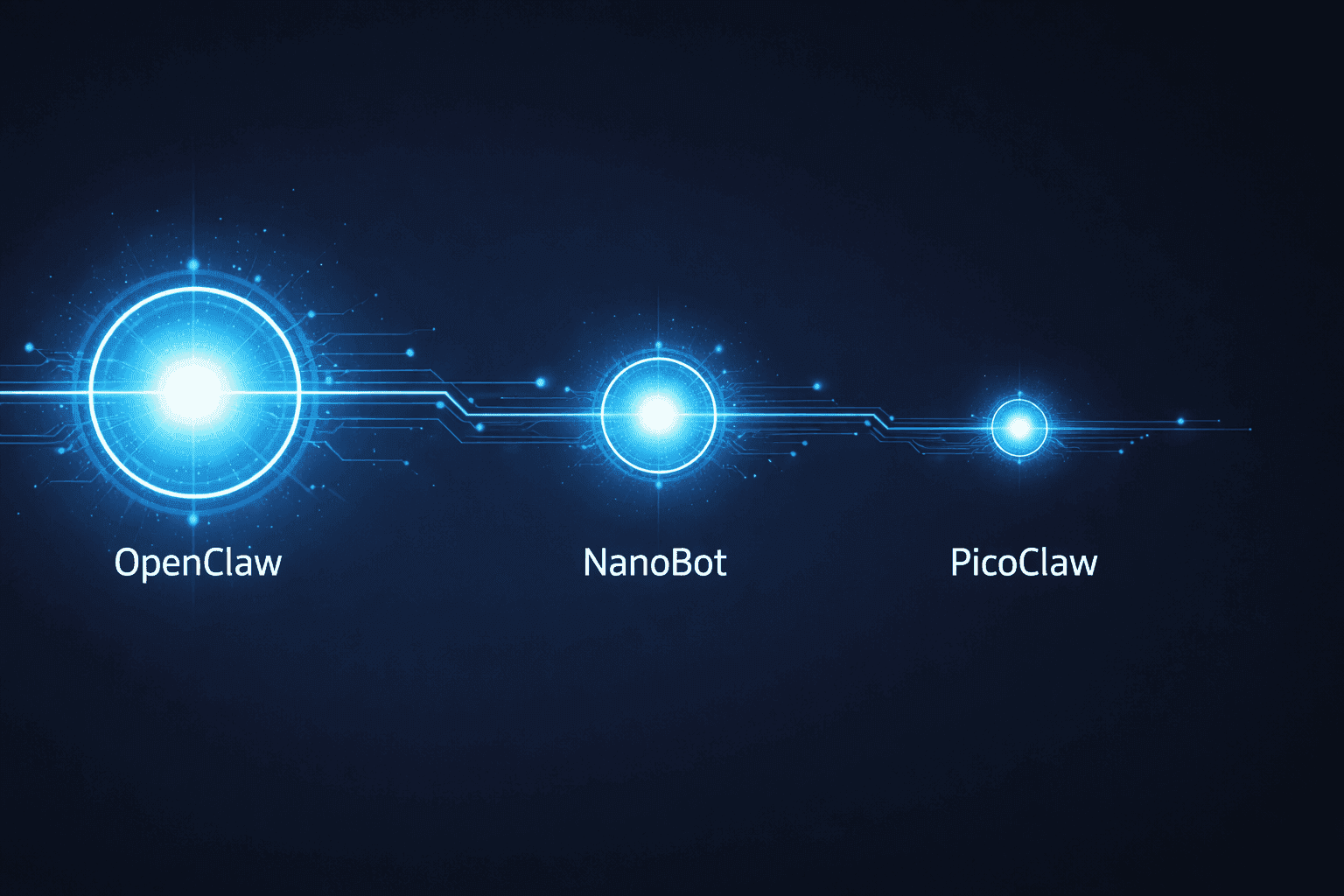
Compare OpenClaw, NanoBot, and PicoClaw — three open-source AI agents. Find the right one for your hardware, use case, and security needs in 2026.

Best AI Agents for Beginners 2026 (No Coding Needed)

Best AI Agents 2026: What Works for Small Teams

The Best AI Tools to Run a One-Person Business in 2026 (No Staff, No Code)

Everyone's demoing AI agents. Here's what actually happens when marketers put them to work on real tasks - an honest look at allmates.ai and four alternatives.

Agentic AI Market Size 2026: The $139B Boom Explained

GPT-5.4 shipped March 5, 2026 with native computer use, scoring 75% on real desktop tasks vs. 72.4% human baseline. Most people will prompt it like a chatbot. Here is how to actually get results.

WordPress.com added write access for AI agents in March 2026. After two weeks testing it for editorial drafts, it saves time on the parts you'd expect — and falls apart where it matters most.

ARC-AGI-3 launched March 26, 2026. Every frontier model scored below 1%: Gemini 3.1 Pro Preview led at 0.37%, GPT-5.4 at 0.26%. Here’s what the interactive agentic benchmark reveals about current AI reasoning limits.

Newsquest runs up to 30 AI-drafted stories a day via 30 AI-assisted reporters. Reuters Institute: 67% of publishers haven't saved jobs from AI yet. Here's what the workflow actually looks like.

Z.AI's GLM-5.1 scored 58.4 on SWE-Bench Pro, edging GPT-5.4 and Claude Opus 4.6 by less than 1.1 points. The benchmark lead is real — the hardware requirement to run it locally is not consumer-grade.
Combining multiple AI coding tools into a unified workflow is delivering measurable productivity gains for developers who get the configuration right. The efficiency argument is real — but the integration overhead is...