Humanoid Robots in 2026: Who Actually Benefits When the Machines Start Walking?
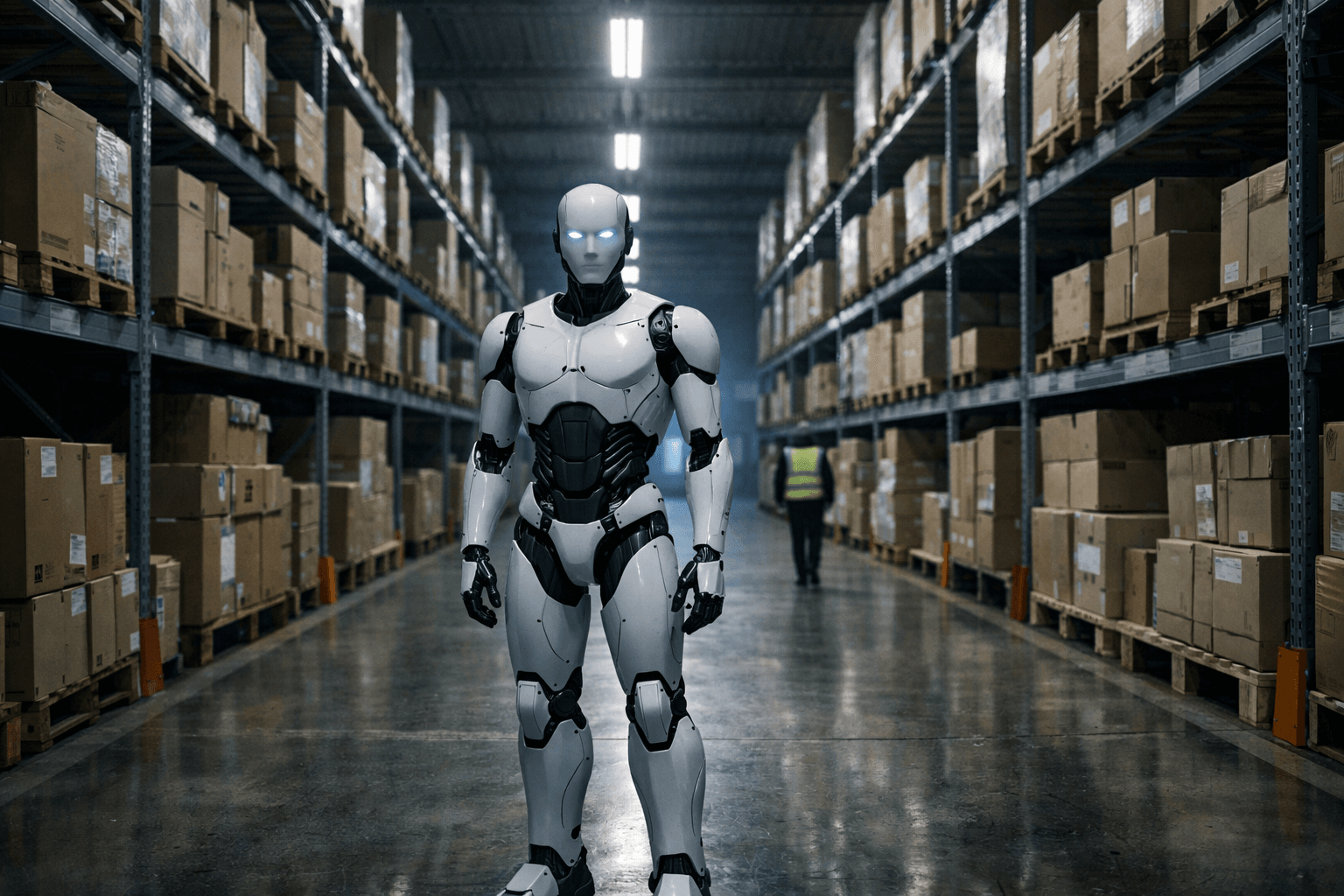
Humanoid Robots in 2026: Who Actually Benefits When the Machines Start Walking?
The press releases call it a "ChatGPT moment for robotics." The question nobody is asking at the product launches is: a ChatGPT moment for whom?
In January 2026, three humanoid robots debuted at CES within 48 hours of each other. LG introduced CLOiD. A startup called Sharpa unveiled North. NEURA Robotics showed humanoid4NE1. Each demo was polished. Each press release promised transformation. None of them spent much time on who would be doing the jobs these robots are designed to replace.
That conversation is worth having now — before the adoption curve gets too steep to steer.
What Changed in 2026
For two decades, humanoid robots existed in labs and TED talks. They stumbled on stairs. They required highly controlled environments. They were expensive to build, fragile to operate, and nowhere near cost-competitive with human labor.
Something shifted. Three technologies converged at once.
The first is the vision-language-action model — VLA for short. These are AI systems that don't just see the world; they interpret it and plan within it. A VLA model can watch a factory floor, understand what task needs doing, and direct a robot's limbs to do it. NVIDIA's Isaac GR00T N1.6, released in early 2026, enables full-body humanoid control using exactly this approach. It processes visual input, maps it to language-level reasoning, and translates that into physical action.
The second is hardware maturity. Actuators — the mechanical joints that let robots move — are finally precise and durable enough for real work environments. Earlier generations burned out fast. Current designs handle repetitive industrial tasks across multi-shift schedules.
The third is cost. The price per unit for a capable humanoid robot has dropped significantly as component manufacturing scaled. That makes the ROI calculation much easier for large operations running on thin labor margins.
Where Robots Are Actually Being Deployed
The adoption numbers are real. According to a Deloitte analysis published in early 2026, 58% of enterprises are already using some form of physical AI in their operations. That number is projected to reach 80% within two years.
The sectors leading adoption are specific: manufacturing, logistics, defense, and agriculture. These are industries with three things in common — high labor demand, high physical repetition, and increasing difficulty recruiting human workers at prevailing wages.
In logistics, humanoid robots are being piloted in warehouse pick-and-pack operations. The task is repetitive, physically demanding, and notoriously hard to staff. Amazon, DHL, and several Asian e-commerce operators have announced or expanded physical AI deployments in 2026.
In manufacturing, the pitch is precision at scale. Automotive assembly lines, semiconductor fabs, and electronics manufacturing all require consistent fine-motor work across long shifts. Robots don't fatigue. They don't need breaks. They don't file workers' compensation claims.
In agriculture — one of the least-discussed adoption sectors — pilot programs in Japan, South Korea, and parts of the EU are testing humanoid systems for harvesting and sorting, tasks that have historically resisted automation because they require adaptable manipulation.
The Labor Question Nobody Is Answering
The OECD's 2025 Employment Outlook estimated that roughly 27% of jobs in OECD countries are at high risk of significant automation impact over the next decade. Physical AI accelerates that timeline for manual and semi-skilled work specifically.
This is not a distant projection anymore. It is a 2026 deployment roadmap.
What's striking is how little of the public conversation around humanoid robots engages with this directly. Company announcements focus on "augmenting human capabilities" and "addressing labor shortages." Both framings are technically true and strategically incomplete.
Yes, some sectors face genuine labor shortages. Japan has an aging population and a manufacturing base that depends on manual labor. The EU's agricultural sector has relied heavily on seasonal migrant workers who are increasingly difficult to recruit. For those use cases, physical AI fills a gap.
But "filling a labor shortage" and "displacing workers" are not mutually exclusive. The workers who do exist in those industries — the ones who haven't quit, who stayed through the hard years, who built up institutional knowledge — are the ones whose jobs become uncertain as robots reach cost parity.
The IMF's 2025 World Economic Outlook flagged that automation transitions historically concentrate displacement in a narrow band of worker age ranges: late 40s to mid-50s. Workers old enough to have built their careers around manual skills, young enough that retirement is not an immediate option, and underrepresented in the retraining programs that get announced alongside automation investments.
The Infrastructure Behind the Hype
Understanding who benefits also means understanding who builds the infrastructure.
NVIDIA is not selling humanoid robots. NVIDIA is selling the picks and shovels. Its NemoClaw platform, announced in March 2026, is an enterprise-grade development environment for building AI agents — including physical ones. Its Physical AI Data Factory Blueprint provides the software scaffolding for training robots on synthetic and real-world data at scale.
Jensen Huang framed it plainly at the announcement: AI agents are going into every industry. Physical AI is just agents with bodies.
That framing matters. It positions NVIDIA not as a robotics company — which carries reputational weight around labor displacement — but as infrastructure. The same move worked for cloud providers during the first wave of software-driven automation. Build the platform. Let customers make the labor decisions. Remain upstream of the consequences.
Anthropic, OpenAI, Google DeepMind, and several well-funded startups are building the underlying VLA models. Hardware manufacturers are building the bodies. Integrators are putting them to work. The labor consequences accumulate at the point of deployment — far downstream from where the capital and the press attention sit.
What to Watch in the Next 18 Months
Three things will determine how this plays out.
Regulatory response. The EU AI Act covers high-risk AI systems but has limited provisions specifically governing physical AI in labor contexts. Several EU member states are pushing for extensions. The US has no federal framework. Labor unions in Germany, France, and South Korea are already organizing around automation disclosure requirements — demanding that companies notify workers before deploying robots in roles currently held by humans.
Cost curves. If humanoid robot unit costs continue to fall — analysts project another 30–40% reduction by late 2027 — the ROI case becomes compelling even in sectors that currently aren't close to deploying. Retail. Food service. Building maintenance.
Retraining infrastructure. Every government announcement about automation includes a paragraph about retraining programs. Almost none of them come with funding at the scale the displacement will require. The gap between stated commitment and actual investment is where workers fall through.
The Honest Summary
Physical AI in 2026 is real, commercially viable, and accelerating. The technology works. The deployment is happening. The market incentives are aligned for adoption to outpace policy response.
That does not make it malign. It makes it consequential. And consequential technologies deserve scrutiny proportional to their impact — not just the product launches they get.
The "ChatGPT moment for robotics" is a useful shorthand for a technology crossing a threshold. What it doesn't capture is what happened after the ChatGPT moment for knowledge work: mass layoffs in content, media, and customer service, conducted quietly and framed as restructuring.
The robots are walking now. The question is who decides where they go.
Sources: Deloitte State of AI in the Enterprise 2026; OECD Employment Outlook 2025; IMF World Economic Outlook 2025; NVIDIA Newsroom March 2026; CES 2026 press materials; Boston Institute of Analytics Agentic AI News Roundup March 2026.